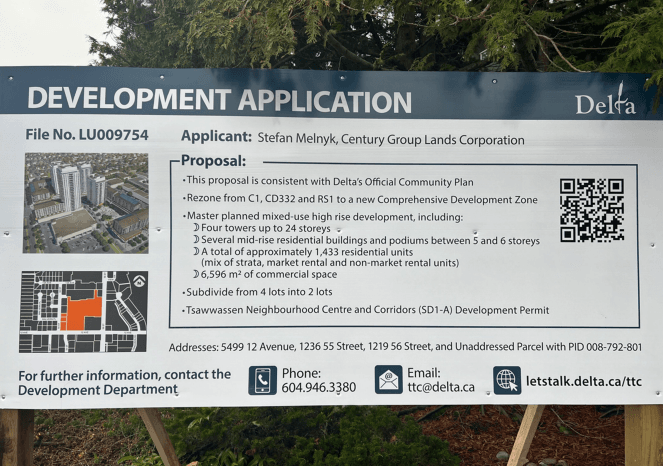
The steering committee at DREAM South Delta held a strategy meeting this week and, amongst other topics, spent some time discussing the letter from Century Group’s President, Mr. Sean Hodgins, to Mayor and Council that accompanied his “revised” proposal to redevelop the Tsawwassen Town Centre Mall.
His letter employs a tone that is ostensibly collaborative but veers into condescension, particularly when addressing opposition to the project. Below, we highlight specific excerpts (in bold) that we interpreted as aggressive (confrontational or belittling), divisive (pitting “opposition” against progress or younger generations), or threatening (implying inevitable change or community decline without the project). These are drawn directly from the text, with brief contextual notes.
- “Fear about the height of buildings and loss of perceived character has been raised by opposition groups that present no practical alternative to see renewal of the town centre.”
Analysis: “Opposition groups” aggressively labels concerned residents or advocates as organized adversaries, implying they are obstructive and unproductive. This divides the community into “fearful opponents” vs. forward-thinking proponents, dismissing legitimate input as lacking merit. The truth is that groups and forums like Delta Voices, Communities Tsawwassen, and DREAM South Delta are looking for development but in a manner that fits and enhances our community.
- “The community of Tsawwassen with its skewed age demographics is a community slowly isolating itself from the next generation who want a chance to live in our community and offer in our health care and retail centres of the future and enjoy the best that Tsawwassen and Delta have to offer.”
Analysis: Labeling demographics as “skewed” and the community as “slowly isolating itself” is divisive and judgmental, pitting older residents against “the next generation.” It aggressively implies current residents are selfishly barring youth, fostering intergenerational guilt and division. Ironically, DREAM South Delta volunteers found that, during Spring engagement activities, many younger families were strongly opposed to the mass densification of the town centre having relocated to South Delta specifically to be able to raise their families in this exact environment.
- “There is little charm in the built environment of the absence of the Town Centre, consisting largely of auto-oriented parking lots that are at odds with the concept of a walkable town core.”
Analysis: While critiquing the status quo, this phrasing aggressively undermines the current community’s appeal (“little charm”), implying residents live in an unappealing, outdated space. It divides by contrasting the “charm-less” present (tied to residents’ preferences) with a superior future vision.
- “Subjective views of character aside, without adding housing supply in forms that are viable in today’s housing market, no project will proceed.”
Analysis: The dismissive “subjective views… aside” sidelines resident input as irrelevant. The declarative “no project will proceed” carries a veiled threat: without acceptance of the developer’s terms (e.g., taller buildings), stagnation or decline is inevitable, pressuring approval.
- “In any event I trust that Mayor and Council are not acceding to fear; rather to hope for the future and what renewal will bring to Tsawwassen…”
Analysis: “Acceding to fear” patronizes the Council by assuming they might yield to irrational pressures, while “hope” positions the developer’s vision as the moral high ground. This subtly threatens repetitional risk if they side with opponents, framing approval as enlightened leadership.
- “Concerns about ‘loss of character’ are hard to address in the absence of actual character in the town centre to defend.”
Analysis: The sarcastic quotation marks around “loss of character” and the phrase “absence of actual character” belittle residents’ emotional attachments, portraying their concerns as irrational or unfounded. This is divisive, as it invalidates cultural or historical value, suggesting opposition is defending something nonexistent.
Overall Analysis: Disrespect to Mayor, Council, and Tsawwassen Residents
The letter’s tone masquerades as responsive and optimistic (“We hope you will love it”; “compelling vision”) but reveals underlying disrespect through paternalism and erosion of agency. It frames revisions as concessions granted despite community “fear” and “concerns,” rather than genuine dialogue, reducing public input to obstacles overcome by the developer’s expertise. This disrespects the Mayor and Council by questioning their discernment (“not acceding to fear”) and implying they need guidance from the OCP and developer to make “bold” decisions—positioning Hodgins as the one true visionary, not elected officials.
For Tsawwassen residents, the disrespect is more profound and personal: concerns are pathologized as “fear” or “subjective,” the town’s identity is derided as charmless and isolating, and the community is depicted as demographically flawed and in need of external salvation. This divisive rhetoric alienates stakeholders, portraying opposition not as valid civic engagement but as barriers to progress, which could intimidate or demoralize participants. By invoking generational conflict and market inevitability, the letter threatens community cohesion, suggesting non-approval equates to self-sabotage and decline.
Ultimately, it prioritizes corporate narrative over empathetic partnership, eroding trust in a process meant to serve local voices.
This letter can be found on page 2 and 3 of the new proposal package to Delta.